
Overview
This guide addresses the critical safety concern of keeping medication-laced pet food separate in multi-pet households, where accidental ingestion or underdosing can lead to serious health emergencies. It outlines five practical feeding separation methods—including physical room separation, sequential feeding, elevated stations, barrier feeding, and microchip-activated feeders—to help pet owners protect their animals while reducing mealtime stress.
Table of Contents
- Why Feeding Station Separation Keeps Your Pets Safe
- Physical Room Separation: The Most Reliable Option
- Timed Sequential Feeding for Busy Households
- Using Height Differences to Your Advantage
- Supervised Barrier Feeding
- Microchip-Activated Feeders: A Smart Hands-Off Solution
- Essential Safety Guidelines Every Multi-Pet Owner Should Know
- What To Do Right Now
- Training Your Pets for Calmer, Safer Mealtimes
- Conclusion
- Frequently Asked Questions
If you share your home with more than one pet — and at least one of them takes medication — you are probably no stranger to mealtime stress. Keeping each pet’s food and medication separate feels simple in theory, but in practice it can be genuinely worrying. The good news is that there are proven strategies that work, and you do not need a complicated setup to keep everyone safe.
This article is for informational purposes only and is not a substitute for professional veterinary advice. Always consult a licensed veterinarian for diagnosis and treatment.
Whether you are caring for a diabetic cat alongside a healthy dog, or managing two pets with completely different prescriptions, feeding station separation is not just convenient — it is essential for their safety. This guide walks you through five practical methods to help you find what works best for your home and your pets.
Why Feeding Station Separation Keeps Your Pets Safe
When a pet consumes another animal’s medication, the consequences can range from mild discomfort to a serious emergency. The ASPCA Animal Poison Control Center lists medication ingestion among the top reasons for emergency calls from pet owners.
There are two risks worth understanding:
- Underdosing: Your pet misses their medication entirely, which may allow their condition to worsen.
- Accidental ingestion: A pet consumes medication intended for another animal, which could be harmful or toxic depending on the drug and species involved.
Some medications that are safe for dogs may be highly dangerous for cats, and vice versa. Even within the same species, one pet’s prescription could be harmful to another.
Beyond physical health, there is an emotional cost too. Constantly worrying whether each pet ate the right meal is exhausting. Pets also pick up on your anxiety, which can lead to food guarding, stress, or reluctance to eat.
It is completely normal to feel worried about this — catching the problem early and putting a plan in place puts you in a great position to protect all of your pets.
Physical Room Separation: The Most Reliable Option
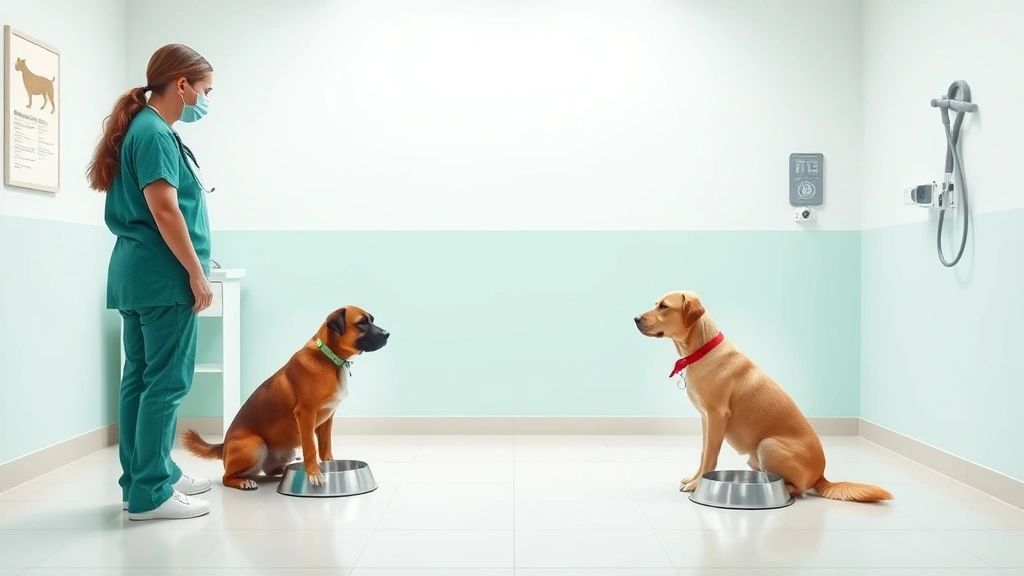
The most reliable approach is also the simplest: feed your pets in completely separate rooms with closed doors between them. This gives you absolute certainty that each pet only accesses their own meal and medication.
Bedrooms, bathrooms, laundry rooms, or home offices all work well. The key is choosing a space where the door closes securely and where your pet feels comfortable. Consistency matters — use the same room every time so your pet knows what to expect.
This method is especially helpful for pets who are anxious around food or tend to guard their bowl. Removing the competition entirely can make mealtimes calmer for everyone.
Here is how to make it work smoothly:
- Deliver meals to each room at the same time or in quick succession.
- Set a timer so you do not forget a pet in a closed room.
- Visually confirm each pet has finished — including any medication — before opening doors.
- Check for medication hiding. Some pets are skilled at eating around pills.
- Never leave pets unattended in closed rooms for extended periods.
The main limitation is space. You need enough separate rooms in your home. But if you have them, this method requires no special equipment and is highly effective.
Timed Sequential Feeding for Busy Households
If separate rooms are not practical, sequential feeding is an excellent alternative. Instead of feeding all pets at once, you feed them one at a time in a predictable order.
Choose an order that suits your household and stick to it. Predictability helps your pets settle into the routine faster and reduces anxiety around mealtimes.
Crates or carriers work well here. While one pet eats, the others wait comfortably in their crates with a favourite toy. Once the first pet finishes, they are released and the next takes their turn.
A few tips to make sequential feeding easier:
- Reward calm, patient behaviour when it is not a pet’s turn.
- Use a consistent cue like “wait” to signal patience, and a release word like “okay” when it is their turn.
- Start with short waiting periods and gradually extend them.
- Reward the first pet for moving away calmly after finishing.
- Make sure crates are already familiar, positive spaces — do not introduce them solely for this purpose.
This method adapts well to different schedules and can be done anywhere in your home. For more guidance on managing multiple pets, visit our comprehensive pet care resources.
Using Height Differences to Your Advantage
Most cats are comfortable eating at elevated surfaces. Most dogs prefer ground level. This natural difference can become a practical separation solution in your home.
Wall-mounted shelves or raised feeding stations placed at counter height or above can put a cat’s food well out of reach of most dogs. Similarly, a large dog’s raised feeder may be inaccessible to a smaller pet.
This approach works particularly well in multi-species households or homes with pets of very different sizes.
Key things to keep in mind:
- Make sure the station is genuinely out of reach for the pet it is not intended for.
- Confirm the intended pet can access it comfortably and safely.
- Provide steps or a ramp for older cats or those with mobility challenges.
- Monitor your pets over time — jumping ability can change as pets age.
- Consider keeping both elevated and ground-level options available for flexibility.
Keep a close eye on senior or arthritic pets with this method. A station that was easy to reach a year ago may now be a struggle. A slightly raised platform may offer a better posture for eating without creating an accessibility problem.
Supervised Barrier Feeding
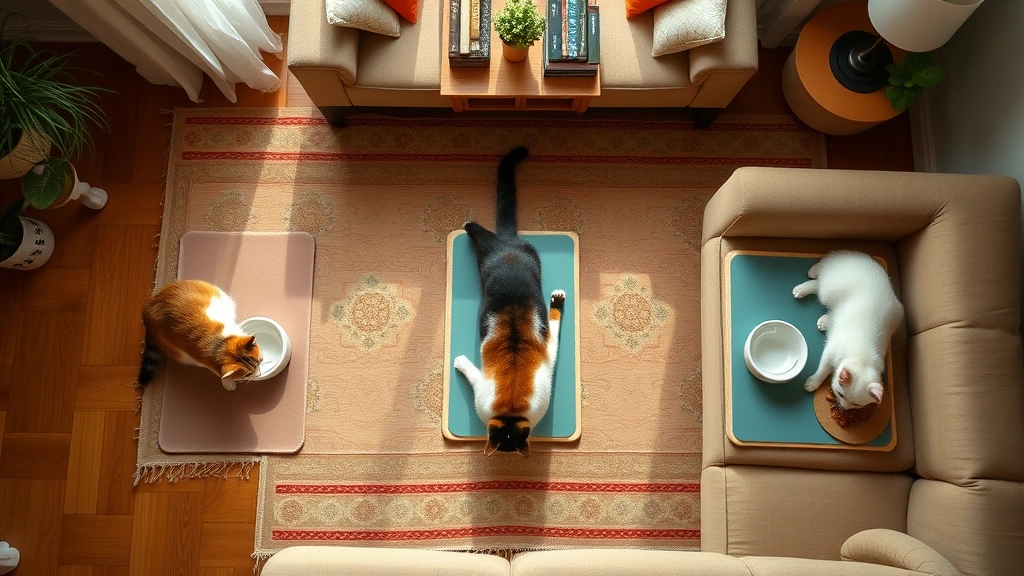
Sometimes you need separation without complete isolation. Barrier feeding uses physical dividers — such as baby gates or exercise pens — to create distinct feeding zones while keeping pets in visual contact with you and each other.
This method is a good fit for pets with separation anxiety. Some animals become genuinely distressed when fully isolated, even briefly. A barrier lets them see you and feel reassured while still preventing access to another pet’s food.
When choosing a barrier, consider:
- Your pets’ size and jumping ability — a gate suitable for small dogs may be easily cleared by a cat or larger dog.
- The layout of your space — exercise pens offer more flexibility in open-plan areas.
- Stability — choose barriers that will not tip if pushed against.
- Gaps — check that a determined pet cannot squeeze through.
Supervision is essential with this method. Unlike a closed door, a gate requires you to stay present and watchful throughout the entire meal. Watch for any attempts to jump over or squeeze around the barrier.
To help your pets accept the barrier:
- Introduce it outside of mealtimes first, so it does not feel threatening.
- Let pets investigate it at their own pace.
- Practise feeding on opposite sides using non-medicated meals initially.
- Reward calm behaviour near the barrier.
- Never use the barrier as a form of punishment.
Microchip-Activated Feeders: A Smart Hands-Off Solution
For pet owners who need a more automated approach, microchip-activated feeders are worth considering. These devices read your pet’s existing microchip or a special collar tag and only open for the designated animal.
When the correct pet approaches, the lid opens. When they move away, it closes. Some models can also be set to open only during specific time windows, which adds another layer of control for medication schedules.
According to AVMA guidelines on pet identification, most pets are already microchipped, making this technology compatible with existing systems for many households.
The advantages include:
- Consistent separation without requiring you to be present at every meal.
- Reduced risk of human error in busy households.
- Useful for pet owners with long or unpredictable work hours.
- Can maintain separation at early morning or late evening medication times.
There are some limitations to be aware of:
- Some clever pets may learn to hover nearby and slip in when the lid opens for another animal.
- The devices require power, which creates a potential failure point.
- Some pets are initially startled by the mechanical sound of the opening lid.
- These feeders work best with dry food or small amounts of wet food.
Quality microchip-activated feeders can represent a meaningful upfront cost. However, many pet owners find the investment worthwhile when weighed against the potential cost of a medication-related emergency. You can find additional guidance in our pet care guides.
Essential Safety Guidelines Every Multi-Pet Owner Should Know
Whichever separation method you choose, these universal safety practices apply whenever you are medicating pets in a shared household.
Always supervise medication administration. Even the most reliable system benefits from a visual check. Some pets eat around pills or hold them in their mouths to spit out later. Others may bring up medication shortly after eating. Only direct observation catches these issues in the moment.
Keep a simple medication log. In households where more than one person handles feeding, a quick record prevents dangerous confusion. A chart on the fridge or a note on your phone works well. Include the pet’s name, the medication, the date, the time, and who administered it.
Store all medications securely. Keep them in a latched cabinet, out of reach of all pets. Never leave pill bottles on counters or tables. Some medications have added flavouring that makes them appealing to animals, which increases the risk of accidental access.
Talk to your vet about timing. Some medications need to be given with food, others on an empty stomach, and some are more flexible. Your vet may be able to adjust schedules so that separation is needed less often — for example, shifting one pet’s dose to morning and another’s to evening.
Act immediately if accidental ingestion occurs. Contact your veterinarian or the Pet Poison Helpline straight away. Have ready: which medication was involved, roughly how much was consumed, and which pet ate it. Do not wait to see whether symptoms appear.
If you are unsure whether your pet needs urgent care, a quick telehealth check-in can give you peace of mind — no appointment needed.
What To Do Right Now
If you are reading this because you are worried about your current setup, here are five practical steps you can take today:
- Write down each pet’s medication details — the name of the medication, when it is given, and with or without food. Keep this somewhere visible, like the fridge door.
- Walk through your home and identify one suitable space for each pet to eat separately — a room with a door, a crate, or a gated area.
- Check where your medications are currently stored and move them to a secure, latched cabinet if they are not already there.
- Set up a simple log — a notepad, a whiteboard, or a note on your phone — so every person in the household can record when each pet has been fed and medicated.
- Choose one separation method from this guide and trial it at the next mealtime, even in a basic form. You can refine it as you go.
Training Your Pets for Calmer, Safer Mealtimes
Even the best separation method needs some training behind it. A little time invested upfront makes a real difference to how smoothly things run day to day.
Start before medication becomes necessary. If you are bringing a new pet into a home where another already takes medication, begin separation routines immediately. If you are adopting multiple pets at once, establish separate feeding stations from day one. This makes separation feel like normal routine rather than a stressful change.
Use positive reinforcement consistently. Reward your pets generously for accepting the new arrangement — whether that means going calmly into their room, waiting patiently for their turn, or eating at their designated station. Rewards can include treats, praise, gentle petting, or a short play session straight after a successful meal.
Expect some initial resistance. Your pets may vocalise, scratch at doors, or try to get around barriers at first — especially if they are used to eating together. Stay calm and consistent. Giving in, even once, can set the training back significantly.
Most pets settle into new feeding routines within one to two weeks. Younger pets tend to adapt more quickly. Simpler methods, like room separation, are often accepted faster than approaches involving unfamiliar equipment.
Track what is working and what is not. This helps you refine your approach and gives you useful information to share with your vet or a behaviourist if challenges persist. For more training strategies, explore our pet behaviour resources.
Conclusion
Managing medication in a multi-pet household does not have to feel overwhelming. The five methods covered in this guide offer practical solutions for a wide range of home layouts, schedules, budgets, and pet personalities.
Here is a quick summary:
- Room separation offers the highest level of certainty.
- Sequential feeding works well when space is limited.
- Elevated stations make use of natural species preferences.
- Barrier feeding maintains connection while preventing mix-ups.
- Microchip feeders provide automated separation for complex situations.
You may find that a combination of methods works best — for example, room separation in the morning when time is short, and barrier feeding in the evening when you can supervise more closely.
The effort you put in now to establish a safe feeding routine will benefit your pets for years to come. You will feel less stressed at mealtimes, and your pets will settle into calmer, more predictable routines.
Your veterinarian is your most important partner in all of this. Do not hesitate to reach out if you are struggling to make a method work — they can help you find a solution that fits your specific situation.
Frequently Asked Questions
What is the safest method for feeding station separation when medicating multiple pets?
Physical room separation with closed doors is generally the most reliable option. It removes any possibility of one pet accessing another’s food or medication. That said, the best method for your household will depend on your home layout, your pets’ personalities, and your daily schedule.
How long does it take for pets to adjust to feeding station separation?
Most pets settle into a new feeding routine within one to two weeks with consistent, calm implementation. Younger pets tend to adapt more quickly. Simpler methods are often accepted faster than those involving unfamiliar equipment or technology.
Can I use baby gates to separate pets during medication time?
Yes, baby gates can work well for supervised barrier feeding. They do require you to stay present and watchful throughout the meal. Make sure the gate is appropriate for your pets’ size and jumping ability, and check for any gaps a determined pet could squeeze through.
Are microchip-activated feeders worth the investment for medication separation?
They can be a good fit for households with three or more pets on different medications, or where work schedules make consistent supervision difficult. They provide automated, reliable separation — but they do have limitations, including cost and the possibility that a clever pet may find a workaround.
What should I do if my pet accidentally eats another pet’s medication?
Contact your veterinarian or the Pet Poison Helpline immediately. Have ready the name of the medication, roughly how much was consumed, and which pet ate it. Do not wait to see whether symptoms develop — acting quickly is important.