
Progressive Retinal Atrophy in Abyssinian cats is an inherited eye condition that slowly robs cats of their vision, often without owners noticing until the disease is well underway. If you share your home with an Abyssinian, understanding this condition can help you catch early warning signs and give your cat the support they need. This guide walks you through what to expect and how your vet can help.
Table of Contents
- What Is Progressive Retinal Atrophy in Abyssinian Cats?
- Why Abyssinians Are Prone to This Condition
- How Progressive Retinal Atrophy Develops Over Time
- Early Signs You Might Notice at Home
- Signs That Appear as the Disease Progresses
- How Vets Diagnose PRA in Cats
- Is There a Genetic Test for Abyssinian Cats?
- Can Progressive Retinal Atrophy Be Treated?
- Helping a Blind or Vision-Impaired Cat Adjust at Home
- Safety Modifications for a Vision-Impaired Cat
- Keeping Your Cat’s Other Senses Sharp
- Emotional Impact on You and Your Cat
- What to Ask Your Vet
- Breeding Considerations and Responsible Ownership
- When to Seek Emergency Care
- Living Well with Progressive Retinal Atrophy
What Is Progressive Retinal Atrophy in Abyssinian Cats?
Progressive Retinal Atrophy, often shortened to PRA, is a group of inherited eye diseases that cause the light-sensing cells in the retina to slowly break down over time. Because these cells cannot regenerate once they are damaged, the vision loss caused by PRA is permanent and cannot be reversed. Abyssinians are one of the breeds most strongly associated with this condition, which means owners of this breed should be especially aware of its signs.
The retina works much like film in an old camera, capturing light and converting it into signals the brain can interpret as images. In cats with PRA, the cells responsible for this process gradually die off, starting usually with the rod cells that handle night vision before moving on to the cone cells used in daylight. This is why many affected cats first struggle to see in dim lighting long before their daytime vision is noticeably affected.
Why Abyssinians Are Prone to This Condition
Progressive Retinal Atrophy in Abyssinian cats is linked to specific inherited gene mutations that have been identified within the breed. Because Abyssinians have a relatively small genetic pool compared to some other breeds, inherited conditions like PRA can appear more frequently when carrier cats are bred together without proper screening.
This does not mean every Abyssinian will develop PRA, but it does mean the breed carries a higher risk compared to many mixed-breed cats. If you adopted your Abyssinian from a breeder, it is worth asking whether the parent cats were screened for retinal disease, as reputable breeders often test for known hereditary conditions before breeding.
How Progressive Retinal Atrophy Develops Over Time
PRA typically develops slowly, often over months or even years, which is part of why it can be so easy to miss in the early stages. Cats are remarkably good at compensating for gradual vision loss by relying more heavily on their sense of smell, hearing, and whisker sensitivity, so they may seem completely normal at home long after their vision has started to decline.
The progression usually starts with reduced night vision, followed by a slow narrowing of the visual field, and eventually can lead to complete blindness in both eyes. The exact timeline varies from cat to cat, and some Abyssinians may retain partial vision well into their senior years, while others progress to full blindness more quickly.
Early Signs You Might Notice at Home
Because cats adapt so well, early signs of PRA can be subtle and easy to dismiss as normal aging or a change in personality. Paying close attention to how your cat behaves in different lighting conditions can help you catch the earliest clues that something may be changing with their vision.
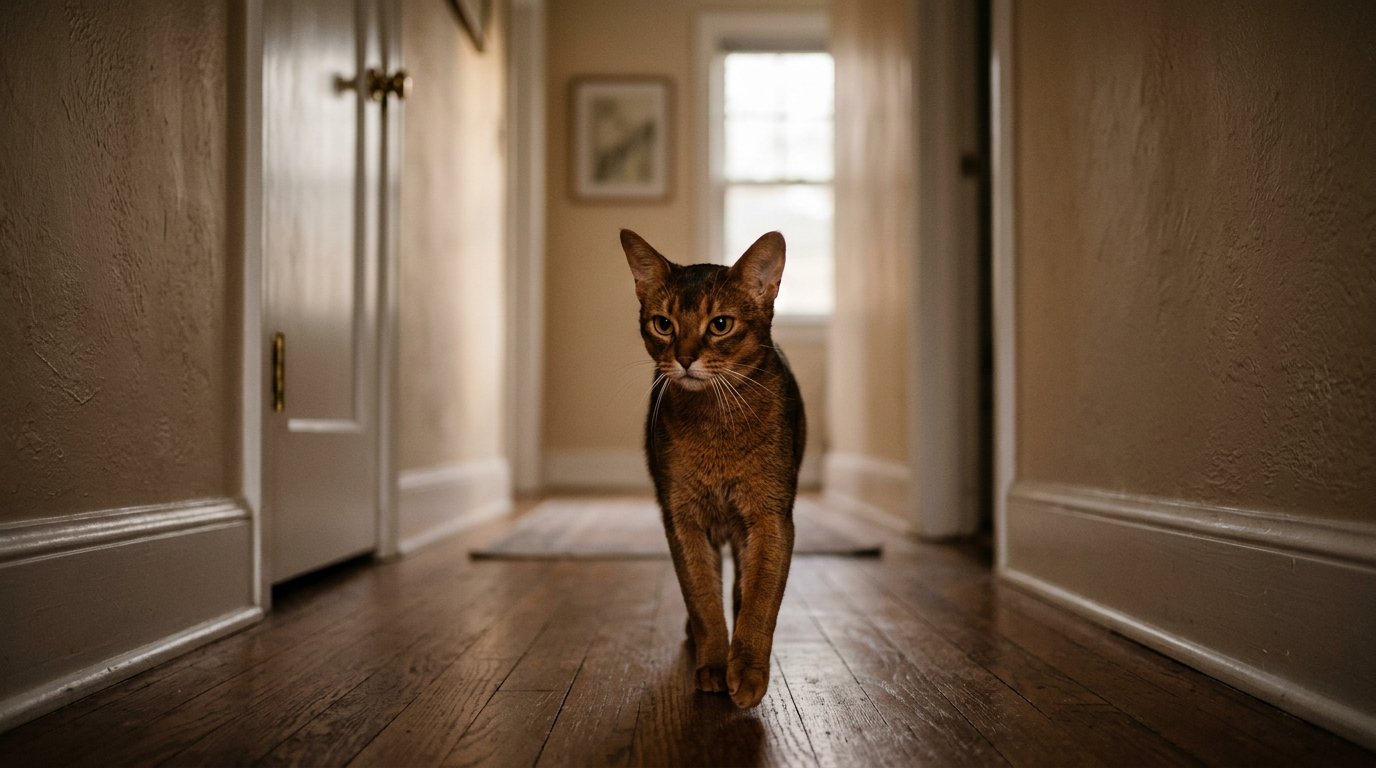
Many owners first notice a problem when their cat becomes hesitant to move around in dim rooms or at dusk, even in a familiar home.
- Reluctance to go down stairs or jump onto furniture at night
- Bumping into furniture that has not moved
- Increased startling when approached suddenly
- Dilated pupils that do not seem to react normally to light
- A noticeable reluctance to play in low-light conditions
Signs That Appear as the Disease Progresses
As Progressive Retinal Atrophy advances, the signs tend to become more obvious and may start showing up even in well-lit rooms. At this stage, many cats begin to rely much more heavily on scent and touch, and you may notice them sniffing their way around furniture or sticking closer to walls when they walk.
Some cats become more vocal, calling out more often as if checking in with their owners for reassurance. Others may seem more anxious in new environments or when furniture is rearranged, since they can no longer rely on visual memory of the space the way they once did.
How Vets Diagnose PRA in Cats
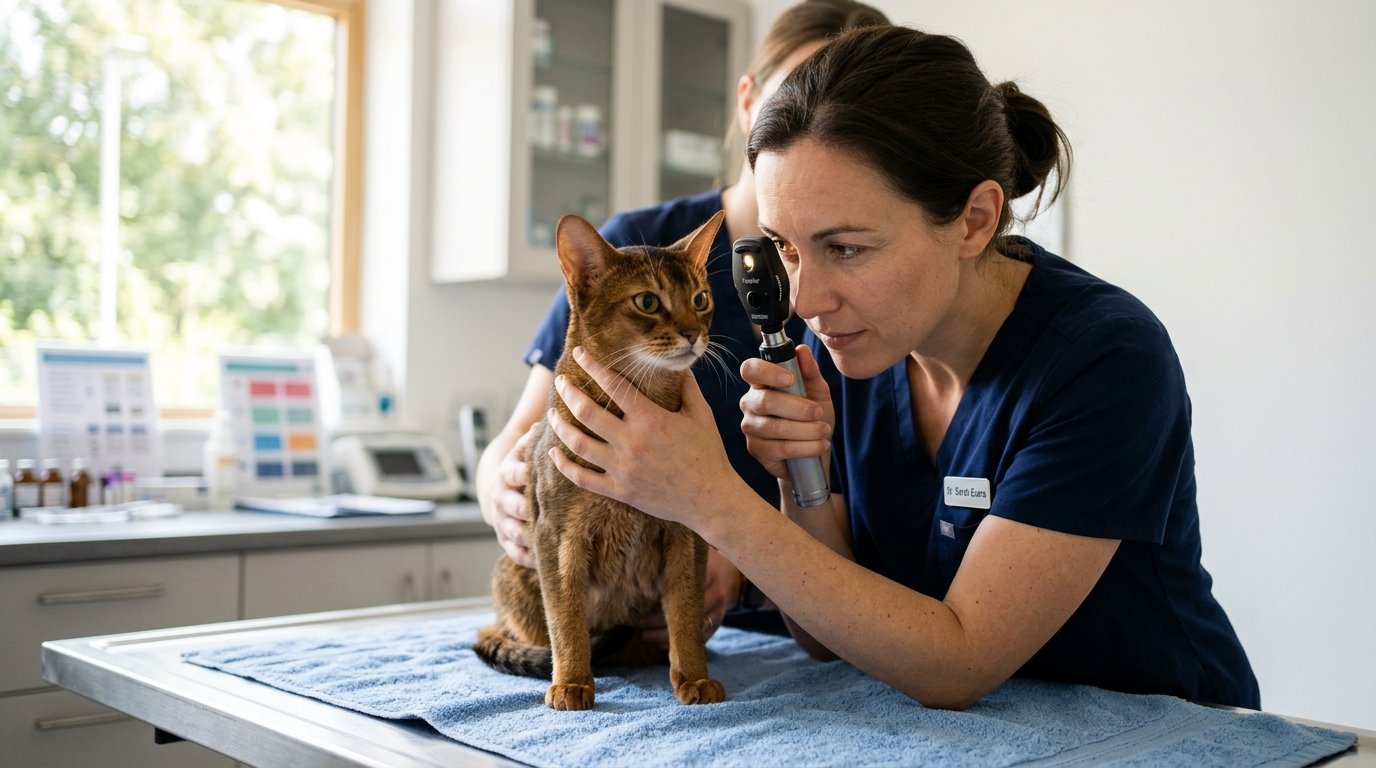
If you notice any signs of vision changes in your Abyssinian, it is important to schedule an appointment with your vet rather than waiting to see if things improve on their own. Your vet will start with a thorough eye examination, often using a specialized instrument to look directly at the retina and assess its health and structure.
In some cases, your vet may recommend referral to a veterinary ophthalmologist for more advanced testing, such as an electroretinogram, which measures the electrical activity of the retina in response to light. This kind of testing can help confirm a diagnosis of PRA and rule out other causes of vision loss, such as high blood pressure or other underlying health conditions.
Is There a Genetic Test for Abyssinian Cats?
Genetic testing has become an increasingly useful tool for identifying cats that carry the mutations associated with hereditary Progressive Retinal Atrophy. A simple cheek swab or blood sample can often be sent to a specialized laboratory to check for known PRA-related mutations in the breed.
Your vet can help arrange this testing and explain what the results mean for your individual cat. Keep in mind that a genetic test can only detect known mutations, so a negative result does not guarantee your cat will never develop any form of retinal disease, but it can still provide valuable information for you and your vet.
Can Progressive Retinal Atrophy Be Treated?
Unfortunately, there is currently no cure or treatment that can reverse the vision loss caused by PRA once it has occurred. This can be difficult news to hear, especially if your cat is still young, but it is important to know that this condition is not painful and does not shorten your cat’s lifespan.
Your vet’s role at this point shifts from trying to save your cat’s vision to helping you manage the condition and support your cat’s quality of life. This may include monitoring for secondary issues, such as cataracts, which can sometimes develop alongside PRA, and ruling out other treatable conditions that could be contributing to vision changes.
Helping a Blind or Vision-Impaired Cat Adjust at Home
Cats are incredibly adaptable, and many blind or vision-impaired Abyssinians go on to live full, happy lives with a few thoughtful adjustments at home. The key is to keep your cat’s environment as consistent and predictable as possible, since they will increasingly rely on memory and routine to navigate their surroundings.
Try to avoid rearranging furniture unnecessarily, and if you do need to make changes, give your cat time to explore the new layout with you nearby for reassurance. Speaking to your cat before you approach or pick them up can also help prevent startling them, since they can no longer see you coming.
Safety Modifications for a Vision-Impaired Cat
A few simple changes around your home can make a big difference in helping your Abyssinian feel confident despite their vision loss. Focusing on safety and consistency will help reduce the number of surprises your cat encounters throughout the day.
Many owners find that small, low-cost adjustments go a long way toward keeping a vision-impaired cat safe and comfortable.
- Block off access to stairs, balconies, or pools if your cat seems disoriented
- Keep food, water, and litter box locations consistent and unchanged
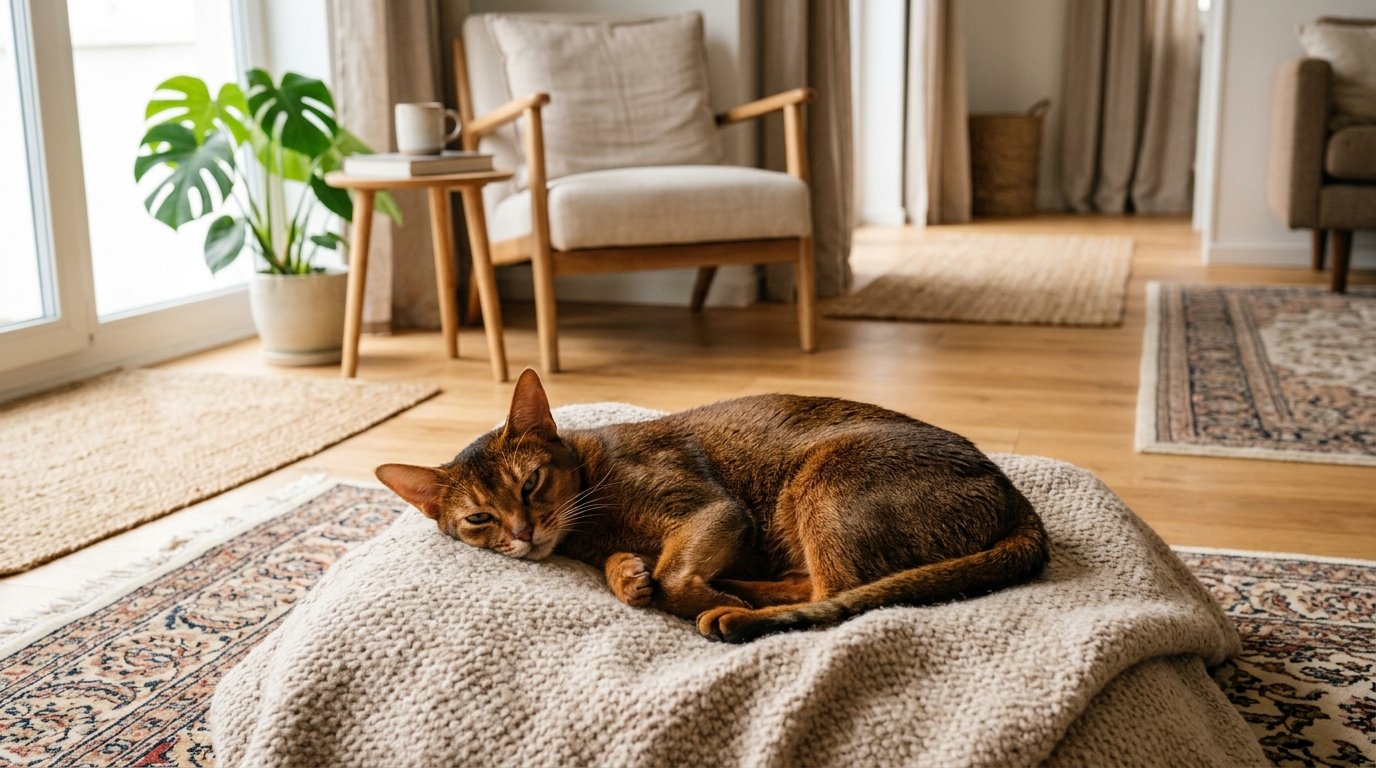
- Use rugs or mats to help your cat feel textural cues around key areas
- Remove sharp-cornered furniture from frequently used pathways
- Consider a scent marker, like a specific fabric softener, near doorways
Keeping Your Cat’s Other Senses Sharp
Since your cat will lean more heavily on hearing and smell as their vision declines, finding ways to enrich these senses can help keep them engaged and mentally stimulated. Toys that make noise, such as those with bells, can be especially appealing to a vision-impaired cat, since they allow play to continue even without clear sight.
Scratching posts, cat trees, and familiar bedding placed in consistent locations also give your cat reliable scent landmarks throughout the home. Talking to your cat more often, especially before touching them, helps them feel more connected to you and less startled by sudden contact.
Emotional Impact on You and Your Cat
Watching your cat lose their vision can be an emotional experience, and it is completely normal to feel worried or even a bit heartbroken as you notice the changes. It can help to remind yourself that cats do not experience the same emotional distress over blindness that humans often imagine, since they adapt gradually and rely less on vision to begin with compared to people.
Most Abyssinians with PRA continue to eat, play, and interact affectionately with their families for years after diagnosis. Giving yourself grace during the adjustment period, while also giving your cat patience as they learn their new normal, can make the transition smoother for everyone in the household.
What to Ask Your Vet
Bringing a list of questions to your appointment can help you make the most of your time with your vet and ensure you leave with a clear understanding of your cat’s condition. This is especially helpful if you are feeling overwhelmed or unsure where to start.
Consider asking your vet how quickly they expect the condition to progress based on your cat’s current exam findings, whether any secondary eye conditions need monitoring, and whether genetic testing might be appropriate for other cats in your household. Your vet can also guide you toward resources or support groups for owners of vision-impaired cats if you would find that helpful.
Breeding Considerations and Responsible Ownership
If your Abyssinian has been diagnosed with hereditary Progressive Retinal Atrophy, it is important not to use them for breeding, as this can pass the condition on to future litters. Responsible breeders typically screen their cats through genetic testing or eye exams before breeding to help reduce the prevalence of PRA within the breed over time.
If you are considering adding another Abyssinian to your family in the future, ask any breeder about their screening practices for retinal disease. Supporting breeders who prioritize genetic health testing helps protect the long-term wellbeing of the breed as a whole.
When to Seek Emergency Care
While PRA itself progresses gradually, sudden vision loss is a different matter and should always be treated as an emergency. If your Abyssinian suddenly appears to go blind overnight or over the course of just a day or two, this could indicate a different, potentially serious underlying issue rather than typical PRA progression.
Conditions such as high blood pressure, retinal detachment, or other systemic illnesses can cause rapid vision loss and may require urgent treatment to preserve any remaining sight or address a more serious underlying health problem. Contact your vet or an emergency animal hospital right away if you notice sudden changes in your cat’s vision, rather than waiting for a routine appointment.
Living Well with Progressive Retinal Atrophy
A diagnosis of Progressive Retinal Atrophy in your Abyssinian cat is not the end of a happy, fulfilling life together. With some patience, thoughtful home adjustments, and ongoing support from your vet, most cats adapt remarkably well to their changing vision and continue to enjoy the things they always have, from cozy naps to playtime with their favorite toys.
Staying observant, keeping up with regular veterinary checkups, and reaching out to your vet whenever something seems off will help you catch any additional issues early and keep your cat as comfortable and confident as possible throughout their life.
This article is for general education and is not a substitute for care from your own veterinarian. Learn about The Pet Vet and our editorial policy.