
Beagle escape behavior puzzles a lot of owners who swear their dog was “right there” a second ago. This breed was built to follow scent trails for miles without looking back, and that instinct can override training, fences, and even a favorite person calling their name. Understanding why Beagles bolt, and what you can do about it, helps keep your dog safe without fighting their nature.
Table of Contents
- Why Beagles Are Wired to Wander
- Common Scenarios Where Beagles Make a Run for It
- The Difference Between Wandering and True Escape Risk
- Physical Containment That Actually Works
- Leash and Harness Choices That Reduce Slip Risk
- Training Approaches That Work With the Nose, Not Against It
- Microchipping and Identification as a Safety Net
- What to Do in the First Minutes After an Escape
- When Escape Behavior Signals a Bigger Problem
- Supporting Your Beagle’s Need for Mental Engagement at Home
- Talking to Your Vet About Persistent Escape Behavior
- Living Well With a Nose-Driven Companion
Why Beagles Are Wired to Wander
Beagles were bred for centuries to work in packs, tracking rabbits and other small game across open country while following scent trails that could stretch for miles. That job required a dog who would commit fully to the trail and tune out distractions, including the voice of the hunter following behind. When your Beagle catches an interesting scent in the backyard or on a walk, that same ancient instinct kicks in, and the nose simply takes priority over everything else, including your recall cues.
This is not stubbornness in the way some owners describe it, and it is not a training failure on your part. It is a deeply ingrained behavioral trait that has been selected for generation after generation. Recognizing that your Beagle is not trying to defy you, but is instead responding to an instinct that feels as urgent as hunger or thirst, can change how you approach prevention and training.
Owners who understand this wiring tend to have more success keeping their dogs safe, because they stop relying on willpower alone and start building physical and environmental safeguards around the behavior.
Common Scenarios Where Beagles Make a Run for It
Escape attempts usually happen in predictable situations once you start paying attention to the pattern. A gate left open for even a few seconds, a gap under a fence, or a moment of distraction during a walk can be all it takes for a Beagle to slip away on a scent trail. Many owners report that their dog seemed perfectly obedient right up until the instant a rabbit, squirrel, or unfamiliar smell crossed their path.
Some of the most frequent triggers include wildlife activity nearby, food smells carried on the wind, and the arrival of new scents from visitors, other animals, or recent weather changes like rain. Beagles can also bolt out of curiosity during walks if a leash is loose or a harness fits poorly, since a sudden lunge toward a smell can slip a collar faster than most owners expect.
- Doors or gates propped open during deliveries, yard work, or guests arriving
- Off-leash moments in yards that are not fully secured
- Loose-fitting collars or harnesses that allow for a quick slip
- Distracted walks near wooded areas, parks, or wildlife-heavy neighborhoods
- Multi-dog households where one dog picking up a scent triggers the others to follow
The Difference Between Wandering and True Escape Risk
Not every moment of nose-to-the-ground sniffing means your Beagle is about to bolt, and it helps to understand the difference between normal exploratory behavior and a genuine escape risk. A Beagle investigating a scent on a secure leash or in a fully fenced yard is simply doing what the breed does best, and this kind of sniffing is actually good for their mental wellbeing. The concern arises when that investigation turns into a committed chase, where your dog’s body language shifts, ears go back, and they start moving with purpose rather than casual curiosity.
Watching for this shift in intensity can give you a few seconds of warning before a full escape attempt. Many owners describe it as watching their dog’s whole demeanor change, as if a switch flipped from relaxed sniffing to single-minded pursuit. Learning to read this moment in your own dog takes practice, but it is one of the most useful behavioral skills a Beagle owner can develop.

Physical Containment That Actually Works
Standard fencing is often not enough for a determined Beagle, especially one who has successfully escaped before and learned that the effort pays off. Beagles are capable of squeezing through surprisingly small gaps, and some will dig under fences if a scent trail leads that direction. Reviewing your yard with this in mind, rather than assuming a fence is a fence, can prevent a lot of heartbreak.
Pay close attention to gaps at ground level, loose boards, and areas where the fence meets gates or structures, since these are the weak points a scent-driven dog is most likely to find. Adding buried wire mesh along the base of a fence, securing gate latches that require more than a nose-push to open, and supervising your dog during the first few weeks in any new yard can all reduce risk significantly.
- Check fence lines regularly for gaps, loose boards, or dug-out sections
- Use self-latching or locking gate hardware rather than simple hook latches
- Consider double-gate entry systems for yards that see frequent foot traffic
- Supervise outdoor time in new or unfamiliar spaces until you know your dog’s habits there
- Avoid relying on invisible or electronic fencing alone, since a strong scent drive can override the deterrent
Leash and Harness Choices That Reduce Slip Risk
Walks are one of the highest-risk times for escape, and the right equipment matters more for Beagles than many owners realize. A collar alone is often not enough, since a sudden pull toward a scent can allow a flexible neck to slip free, especially on dogs with a narrower head shape relative to their neck. A well-fitted harness that distributes pressure across the chest and shoulders gives you more control and reduces the chance of a sudden slip.
Double-connection leashes, which clip to both a harness and a backup collar, add an extra layer of security for dogs with a strong track record of bolting. It is also worth checking equipment fit regularly, since a harness that fit well a few months ago may have loosened or your dog may have gained or lost weight, changing how securely it sits.
- Choose a harness with a secure chest strap rather than a slip-style collar for walks
- Check buckle and clip hardware for wear before every walk
- Consider a backup collar and leash connection for extra security on high-risk routes
- Avoid retractable leashes in areas with wildlife activity, since they offer less immediate control

Training Approaches That Work With the Nose, Not Against It
Fighting a Beagle’s nose directly tends to backfire, but channeling that scent drive into structured activities can reduce the urge to bolt in uncontrolled situations. Nose work games, scent trail training, and puzzle feeders that use smell to engage your dog’s brain give that instinct a job to do in a safe, contained setting. Dogs who get regular, satisfying scent-based enrichment often show less frantic behavior when they encounter interesting smells during everyday walks.
Recall training still matters, but it needs to be realistic about what you are asking of the breed. Practicing recall around mild distractions first, then gradually working up to higher-value distractions like food smells or other animals, builds a foundation that has a better chance of holding up when it counts. Reward-based training with especially high-value treats tends to work better than correction-based methods for this particular instinct, since you are competing directly with a biological drive rather than correcting disobedience.
- Introduce structured nose work games using treats or scented toys indoors
- Practice recall in low-distraction settings before adding real-world scent challenges
- Use high-value rewards that can compete with the pull of an interesting smell
- Keep training sessions short and frequent rather than long and infrequent
Microchipping and Identification as a Safety Net
Even with the best prevention, Beagles occasionally get loose, and having solid identification in place can make the difference in how quickly your dog gets home safely. A microchip registered with current contact information is one of the most reliable forms of identification, since collars and tags can fall off during an escape. Checking that your registration details are up to date after any move or phone number change is a simple step that is easy to forget.
A well-fitted collar with an ID tag adds a visible, immediate layer of identification for anyone who finds your dog before a shelter or vet clinic can scan for a microchip. Some owners also add a GPS tracking tag to a harness or collar, which can help locate a dog in real time during an active search rather than waiting for a stranger to find them.
- Confirm microchip registration details are current, especially after a move
- Use a collar with a legible, up-to-date ID tag at all times
- Consider a GPS tracker as an added layer of security for known escape artists
- Keep a recent photo of your dog accessible in case you need to create lost-pet flyers quickly

What to Do in the First Minutes After an Escape
If your Beagle does get loose, acting quickly and calmly improves the odds of a fast, safe recovery. Start by checking the immediate area along likely scent trails, such as near wooded edges, drainage areas, or wherever wildlife activity tends to concentrate in your neighborhood. Calling in a calm, familiar tone rather than a panicked one can encourage your dog to respond rather than associate the chase with excitement or avoidance.
Enlisting neighbors, posting in local community groups, and contacting nearby shelters and veterinary clinics early gives you more eyes looking out for your dog. Leaving an item with your scent, such as a worn piece of clothing, near the area your dog went missing can sometimes help draw them back if they circle around.
- Search calmly and call in a familiar, non-urgent tone
- Check wooded edges, drainage ditches, and other wildlife corridors first
- Notify neighbors, local shelters, and nearby vet clinics as soon as possible
- Leave a scented item or your dog’s bed near the last known location
When Escape Behavior Signals a Bigger Problem
Occasional scent-driven wandering is part of life with a Beagle, but frequent or increasingly risky escape attempts deserve a closer look. If your dog’s behavior seems to be escalating, or if you notice signs of anxiety, restlessness, or compulsive behavior alongside the escape attempts, it is worth talking to your vet. Some dogs develop heightened scent-driven behavior in response to stress, changes in the household, or underlying medical issues that affect their sense of smell or overall anxiety levels.
A veterinary behaviorist or a certified trainer experienced with scent hounds can help you build a more structured plan if standard containment and training approaches are not reducing the risk. This is especially important if your dog has gotten loose near roads, or if escape attempts are putting them in genuine physical danger rather than just causing a stressful afternoon of searching.
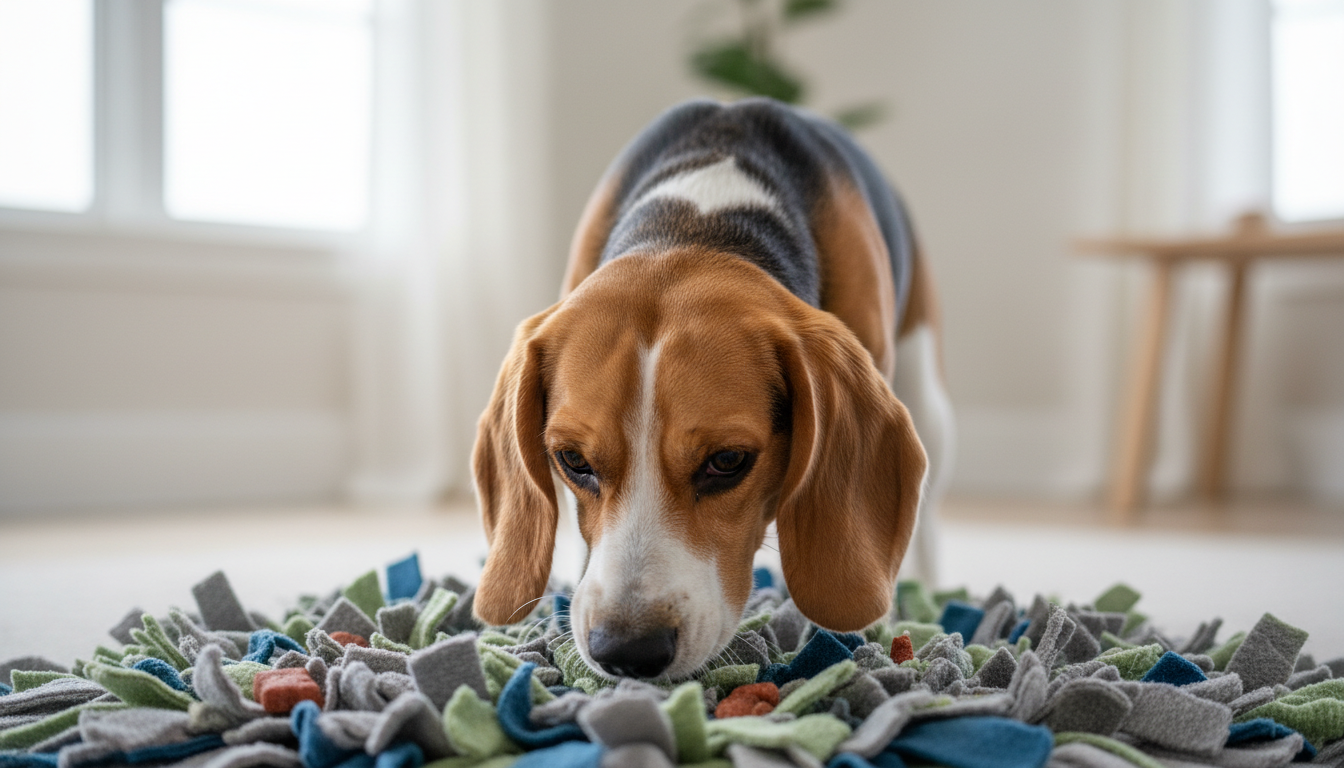
Supporting Your Beagle’s Need for Mental Engagement at Home
A lot of escape behavior quietly improves when a Beagle’s daily life includes enough mental stimulation to satisfy that powerful nose in a safe way. Scattering treats in the yard for a supervised sniffing session, rotating puzzle toys, and setting up short scent trails in the house or garden can all help meet that instinctual need without the risk of a real escape. Dogs who feel mentally satisfied at home often show less desperate, high-intensity interest in outside scents during walks.
Daily physical exercise matters too, since a tired dog generally has less drive to mount an elaborate escape plan. Combining a solid walk or play session with scent-based enrichment tends to work better than either one alone, since it addresses both the body and the nose.
- Set up supervised sniffing sessions in the yard using scattered treats
- Rotate scent-based puzzle toys to keep enrichment fresh and engaging
- Create short, safe scent trails indoors using treats or a favorite toy
- Pair physical exercise with mental enrichment for the best results
Talking to Your Vet About Persistent Escape Behavior
If you have tried reasonable containment, training, and enrichment strategies and your Beagle is still escaping frequently, it is worth bringing this up at your next veterinary visit rather than assuming it is simply the breed being the breed. Your vet can help rule out underlying issues, such as anxiety disorders or sensory changes, that might be intensifying the behavior beyond typical Beagle curiosity. They can also connect you with behavior specialists if the situation calls for more structured intervention.
Never ignore repeated escape attempts as a minor inconvenience, since the risks involved, from traffic to getting lost in unfamiliar territory, are serious. A conversation with your vet is a reasonable next step whenever you feel like you have exhausted your own strategies at home.

Living Well With a Nose-Driven Companion
Life with a Beagle means accepting that their nose will always be one of the most important parts of who they are, and the goal is not to eliminate that instinct but to manage it safely. With the right combination of secure containment, thoughtful equipment, consistent training, and plenty of scent-based enrichment, most owners find a workable balance that keeps their dog safe while still letting them enjoy being a Beagle. Patience and consistency go a long way with this breed, and most escape-related stress eases significantly once a solid routine and secure environment are in place.
Every Beagle is a little different in how strongly their scent drive shows up day to day, so it is worth staying observant and adjusting your approach as you learn your own dog’s particular triggers and tendencies. Working with your vet or a qualified trainer whenever you feel unsure is always a reasonable and sensible step, especially if safety concerns are involved.
This article is for general education and is not a substitute for care from your own veterinarian. Learn about The Pet Vet and our editorial policy.